

Mattress for side sleepers with back pain in NI: choosing firmness and support
The firmest mattress isn’t automatically the best choice for a sore back. For side sleepers, the best mattress for side sleepers with back pain in NI is often soft to medium-firm, with enough cushioning for the shoulders and hips while supporting a neutral spine. Medium-firm is a practical starting point when back pain is part of the picture.
If you wake with aching or pressure around your hips or shoulders, your mattress may be contributing. Side sleeping concentrates pressure on these areas, and a surface that’s too firm may not let them settle comfortably. The right feel depends on how your body meets the mattress, not just the firmness label.
This guide explains how firmness, memory foam and pocket springs affect pressure relief and support, and what to compare when choosing a mattress. You’ll also find practical ways to assess whether a mattress suits your sleeping position and bedroom in Northern Ireland.
Key Takeaways
- Start by comparing soft to medium-firm options, then judge how well each cushions your shoulders and hips while supporting your spine.
- Consider how memory foam contours around pressure points, and compare it with pocket springs for a feel that suits your body and sleeping position.
- Notice whether your hips or shoulders sink too far or feel pressed against the surface; both can help you assess support and pressure relief.
- Look beyond the firmness label: mattress depth, construction and how evenly your weight is supported can all affect comfort on your side.
- Pair mattress support with a pillow that keeps your head aligned with your spine for a more balanced sleeping position.
1. What firmness is best for side sleepers?
For many side sleepers, soft to medium-firm is a sensible range. If you also have back pain, medium-firm is a useful starting point: it can cushion your shoulders and hips while supporting your spine. The best feel depends on your body and how deeply those areas settle into the mattress.
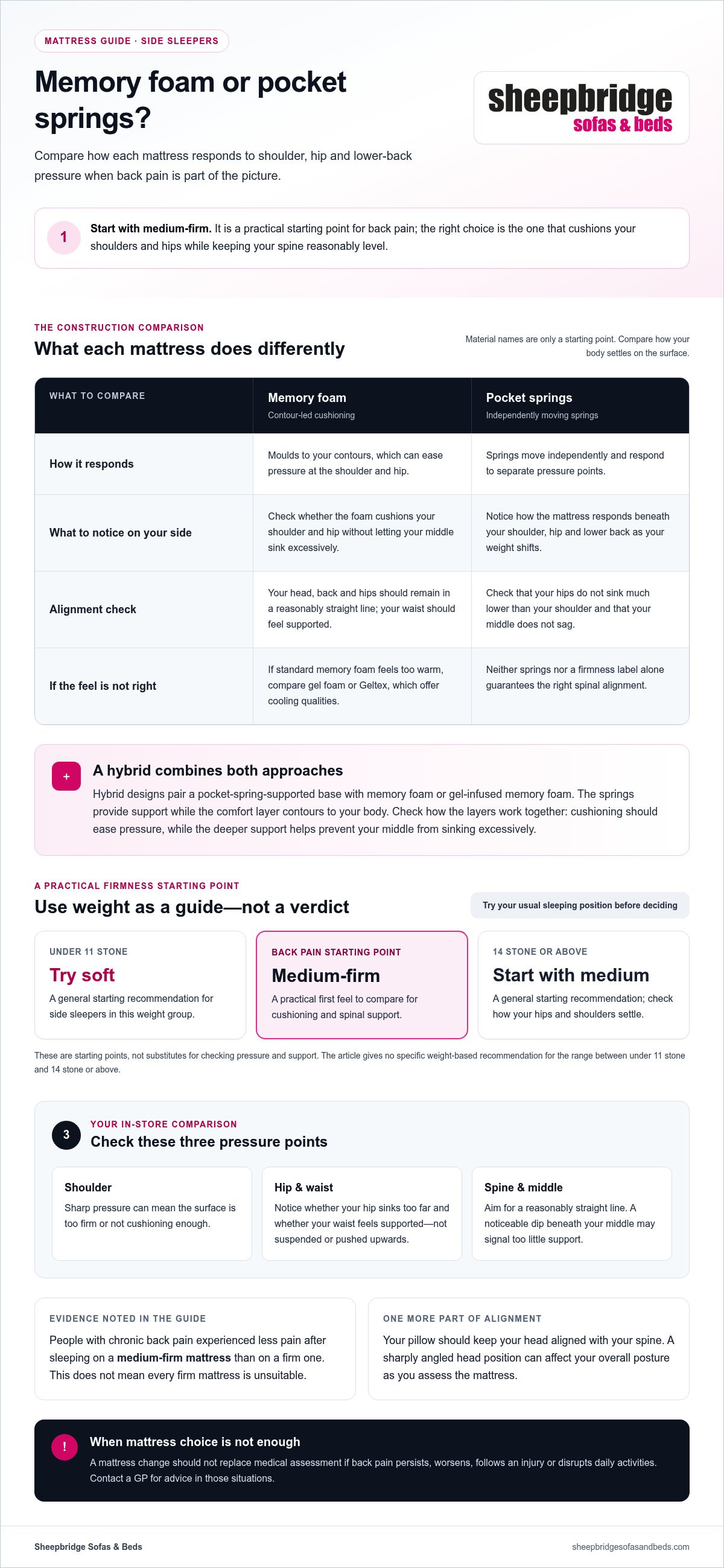
Weight can help narrow the choice. Side sleepers under 11 stone are generally recommended to try soft firmness, while those weighing 14 stone or above can start with medium. These are starting points, not a substitute for noticing whether your hips sink too far or pressure builds at your shoulder.
To see how mattress firmness and spinal support relate to back pain, watch “Choosing a Mattress for Back Pain” from Bob & Brad:
Your sleeping position changes where your body needs pressure relief. When you sleep on your side, your shoulder and hip meet the mattress first, so a very firm surface may feel unforgiving. Back sleepers distribute weight over a broader area, while stomach sleepers may prefer a firmer feel to limit their hips sinking lower than their torso. Comfort also depends on body shape and mattress construction.
When comparing firmness, lie in your usual position and notice whether your spine feels level rather than bent around a dip. Sharp pressure at your shoulder or hip may mean the surface is too firm. If your middle sinks noticeably, it may be too soft or lack support. Pocket springs move independently, helping the mattress respond to different pressure points.
There isn’t one UK price for a mattress suited to side sleepers with back pain. Cost varies with materials, construction and size, so compare similar options rather than relying on firmness labels alone.
For Northern Ireland, check delivery coverage, charges and lead times alongside the mattress details. Stock and delivery arrangements can affect the terms. Trial, return and warranty conditions also vary, so read the requirements and check what the warranty covers before choosing.
2. Which is better for back pain: memory foam or sprung mattresses?
Memory foam and sprung mattresses support the body differently. Memory foam moulds to your contours, which can ease pressure at the shoulder and hip when you sleep on your side. Pocket springs move independently and respond to separate pressure points. Neither material guarantees the right spinal alignment: firmness and how your body settles matter too.
Hybrid designs combine pocket springs with memory foam or gel-infused memory foam, pairing a spring-supported base with a contouring comfort layer. If standard memory foam feels too warm, gel foam or Geltex mattresses offer cooling qualities. Compare how each surface feels around your shoulder and waist instead of choosing by material name alone.
For side sleepers, spinal alignment means keeping the head, back and hips in a reasonably straight line. If your hip sinks much lower than your shoulder, your body may angle; if the mattress barely gives beneath your shoulder, it may create pressure. Zoned support can cushion the shoulder and hip while supporting the lumbar curve. Lie on your side and notice whether your waist feels supported, not suspended or pushed upwards.
A medium-firm mattress is a useful starting point for back pain. The guide reports that people with chronic back pain experienced less pain after sleeping on a medium-firm mattress than on a firm one. This doesn’t make every firm mattress unsuitable, but a hard surface may leave side sleepers’ pressure points under-cushioned. Compare the mattress in your usual position and check whether your hips and shoulders settle without your middle sagging.
A topper can soften a mattress that feels too firm, adding cushioning around the shoulder and hip. It won’t fix a sagging or unsupportive mattress. Cost varies with size, material and thickness, so compare those features with the amount of surface cushioning you need.
Changing your mattress shouldn’t replace medical assessment if back pain persists, worsens, follows an injury or disrupts daily activities. Contact a GP for advice in those situations rather than treating the mattress as the only possible cause.
For a practical comparison, look at how memory foam and pocket sprung mattresses differ in contouring and support. Focus on the feel beneath your shoulder, hip and lower back, not the label alone.
3. The sleep summary: which mattress is best for back pain?
For side sleepers with back pain in Northern Ireland, medium-firm is a practical starting point. The guide reports that people with chronic back pain experienced less pain after sleeping on a medium-firm mattress than on a firm one. Your body should settle without the hips dropping too far or the waist losing contact with the surface. A mattress that spreads your weight more evenly can reduce concentrated pressure and help maintain spinal alignment.
Think of support as a balance between the comfort layers and the base beneath them. Memory foam can contour around your shoulder and hip, while springs respond as your weight shifts. A hybrid combines spring support with foam layers, giving each material a different role. Check how the layers work together: a soft top can cushion pressure points, but the deeper support should keep your middle from sinking excessively.
Your pillow also affects your sleeping posture. It should keep your head aligned with your spine, rather than tilting it towards the mattress or ceiling. When lying on your side, compare the gap between your neck and shoulder with the pillow’s height. If your head angles sharply, adjust the pillow before judging the mattress, as both affect your overall position.
Back sleepers distribute weight across their shoulders, back and hips. Side sleepers put more concentrated pressure on the shoulder and hip. A surface that feels supportive on your back may feel too firm at the shoulder when you roll onto your side. Test both positions if you change posture overnight. Pocket springs, memory foam and hybrid constructions respond differently as your weight shifts.
When comparing mattresses, lie in your usual position, relax your shoulders, then notice whether your waist and hips feel supported. Look for comfort without a pronounced dip beneath your middle, and pressure relief without a hard push against your shoulder. Repeat the check on your back if you sleep in both positions. This is more useful than choosing by construction alone, because the same spring system or foam layers can feel different at different firmness levels.
For side sleepers, the best choice cushions the shoulder and hip while providing steady support through the lower back. A mattress that feels comfortable at first should also let you change position without feeling trapped in a dip. Compare it in your usual sleeping posture, then use your pillow to keep your head level with your spine.
4. Pressure relief for shoulders, hips and joints
For side sleepers with back pain, look for a mattress that cushions the shoulders and hips while supporting the spine. Medium-firm is a useful starting point because it can balance pressure relief with support. Firm and extra-firm surfaces may feel too rigid at these contact points, making it harder for your body to settle comfortably.
Construction affects how a mattress distributes pressure. Pocket springs move independently, allowing the mattress to respond around a shoulder or hip rather than shifting as one unit. Memory foam moulds to the body’s contours, while hybrids combine springs with foam or gel-infused foam. Compare the feel beneath your shoulder, hip and waist, not just the material label.
Try a simple side-sleeping check in the position you use at home. Lie on your side and relax your shoulder rather than bracing against the surface. Notice whether your hip settles without a sharp pressure point and whether your waist still feels supported. If your shoulder feels pushed upwards or your hip feels compressed, the surface may be too firm for your pressure needs.
Body shape affects where pressure builds. A prominent shoulder, for example, may need deeper cushioning than the waist, while a broader hip may press more firmly into the mattress. Zoned support can cushion the shoulders and hips while supporting the lumbar curve. Aim for a neutral spine, without the hip or shoulder forcing your body into a visible curve.
People with sensitive joints or chronic discomfort may prefer medium or medium-soft firmness with deep contouring. A softer surface can let the shoulder and hip settle, while the underlying support helps prevent the middle from sinking too far. A very soft mattress may feel comfortable at first, but check whether your back remains supported after resting in your usual position.
Compare pressure relief in a few positions before deciding. Start on your side, then roll onto your back and notice whether the mattress still supports you evenly. Pocket springs can respond as you move; foam layers can contour where your body presses down. If you share the bed, notice whether movement on one side affects the feel on the other. Choose a construction that cushions your main pressure points without sacrificing support through your back.
5. Mattress features for side sleepers with back pain
Look beyond the firmness label when comparing mattresses for side sleeping with back pain. The surface should cushion your shoulder, hip and knee, while the layers beneath support your spine. Medium or medium-soft with deep contouring may suit people with sensitive joints or chronic discomfort. Your sleeping position is the key test: notice whether your body settles evenly rather than tilting around a pressure point.
Depth is another practical feature. A mattress at least 25 cm deep is generally recommended for side sleepers to help prevent bottoming out. This matters when your shoulder and hip press into the surface, especially if thinner comfort layers leave you feeling the firmer base underneath. Check how the mattress feels at those contact points, not only its overall height.
Construction affects how a mattress responds as you move. Foam can contour around the shoulder and hip, while pocket-sprung designs use independently moving springs. A hybrid combines pocket springs with foam or gel-infused foam layers. You may, for example, prefer a contouring top with a responsive sprung base. Check that your waist remains supported as your shoulder and hip settle.
Use this practical comparison when testing a mattress:
- Lie in your usual side-sleeping position and relax your shoulder.
- Notice whether your hip sinks comfortably or feels pressed against the surface.
- Check that your waist feels supported, without a pronounced dip.
- Roll onto your back and see whether the mattress still feels balanced.
A bed base also matters. For a slatted frame, slats should be spaced no more than 7 cm apart. Wider gaps may leave parts of the mattress less supported, changing how the surface feels beneath your hips. Follow the mattress maker’s guidance for the base and for rotating the mattress. If rotation is recommended, doing it regularly can help promote even wear.
Age and visible wear can offer another clue. A mattress lifespan can be 7-10 years, and replacing one may be worth considering if it is over 7-8 years old, visibly sagging and associated with back pain. Look for a dip beneath your usual sleeping position; a topper may soften a surface, but it won’t remove a sag in the support beneath.
Use these features to compare mattresses for side sleepers and focus on the fit between surface cushioning and underlying support. The clearest takeaway is simple: choose a mattress that cushions your pressure points without allowing your middle to sink out of alignment.
Sheepbridge Sofas & Beds: Manual Recliner Sofas
Sheepbridge Sofas & Beds offers Manual Recliner Sofas for relaxing when you want a comfortable place to sit after a long day. They’re a separate choice from a mattress, but can complement your bedroom comfort with a supportive seat for reading or unwinding.
If you’re furnishing a living room too, compare Corner Sofas, Electric Power Recliner Sofas and Fabric Sofa Suites to find an option that suits your space and routine. Choose a mattress for your sleeping position and support needs, and consider seating separately for daytime comfort.
For help exploring the furniture range, contact Sheepbridge Sofas & Beds.
Make your next comfort choice with confidence
Before deciding, note what you want your sleep setup to do for you. Consider how you feel when you wake, which position you sleep in most, and what matters most in a new mattress. These priorities make it easier to compare options clearly instead of being swayed by a firmness label alone.
The best mattress for side sleepers with back pain in NI is a personal choice, so take time to decide. Consider how it fits your routine and bedroom, then narrow your shortlist to features that address your main comfort needs. If you’re also planning a wider home refresh, explore bedroom and living-room furnishings together.
Sheepbridge Sofas & Beds is a local option for exploring furniture for your home. For a friendly next step, contact Sheepbridge Sofas & Beds and browse the range at your own pace. A thoughtful choice can make your home feel more comfortable, one room at a time.
Frequently Asked Questions
Can my mattress cause hip or shoulder pain?
Yes, a mattress can contribute to pressure and discomfort around your hips or shoulders. A firm surface, for example, may press against the shoulder you sleep on, while a sagging area can leave your hip lower than the rest of your body. Note where you feel discomfort and whether it changes when you sleep in another position. That pattern can help you judge whether the mattress surface needs attention.
How do I know if my mattress is causing back pain?
Morning discomfort that eases after getting up can be one clue to review your mattress and sleeping position. The guide identifies lower-back stiffness that fades after 30 minutes of movement as a possible sign that replacement is worth considering. Back pain that eases within an hour of getting up can also relate to sleep alignment. Track how you feel on waking and whether symptoms change after nights elsewhere.
What firmness is best for side sleepers?
Soft to medium-firm is the recommended range for most side sleepers. As a starting guide, side sleepers under 11 stone are generally suited to soft firmness, while those weighing 14 stone or above can begin with medium. If you fall between those weights, compare how your shoulders and hips settle. A mattress should cushion those contact areas without letting your middle sink noticeably below them.
What is the best mattress for a bad back?
Medium-firm is a practical place to start if you have back pain. Assess the fit in your usual sleeping position: notice whether your lower back feels supported, rather than pushed upwards or left in a pronounced dip.
Which materials support back health: memory foam, latex or hybrid?
Memory foam contours to the body and can cushion pressure points. A hybrid combines pocket springs with memory foam or gel-infused memory foam, pairing a spring base with a contouring layer. Latex has a different feel, commonly more buoyant than foam. Compare how easily you can change position and whether your hips and shoulders settle comfortably. The material name alone doesn’t tell you how supportive the finished mattress feels.
Which is better for back pain: memory foam or sprung mattresses?
Neither material is automatically better for every back. Memory foam moulds around your body, while pocket springs move independently as you change position. Construction and feel are more useful comparison points than material alone. If you want contouring with a more responsive base, for example, compare a hybrid. Check that the mattress supports your lower back while letting your shoulder and hip settle.
How does sleeping position impact back pain at night?
Your sleeping position changes where your body presses into the mattress. Side sleeping concentrates pressure at the shoulder and hip, while back sleeping spreads contact across a broader area. If you change positions overnight, assess comfort in each rather than judging the bed from a single test. A supportive pillow matters too: it should keep your head aligned with your spine, not tilted sharply towards or away from the mattress.
What type of mattress is best for back pain?
If you’re comparing the best mattress for side sleepers with back pain in NI, start with a medium-firm feel and assess support in your normal sleeping position. Memory foam, pocket springs and hybrid constructions respond differently to body pressure. Compare how your waist, hips and shoulders feel together, then consider whether you prefer more contouring or a springier response. The right choice supports your posture without creating uncomfortable pressure.