

Avoiding Hidden Costs When Buying a Sofa in NI: Calculate the Full Cost
The sofa price is only the starting point: avoiding hidden costs when buying a sofa means adding delivery, assembly and any protection treatment to your budget, then considering how long the sofa is likely to serve your household. A low upfront price may not represent the best value if the sofa doesn’t suit daily use or fit through your home’s access points. A practical budget starts with the full delivered cost and the sofa’s expected lifespan.
It’s easy to focus on the look and price of a new sofa, especially when refreshing a room. Checking the details early can help prevent unexpected charges, delivery complications and a purchase that doesn’t work in your space.
This guide explains how to calculate the full cost, compare upholstery and care needs, and plan delivery in Northern Ireland. You’ll also find practical measuring tips for rooms, doorways, hallways and stairs, so you can make an informed choice before ordering.
Key Takeaways
- Measure the room and the route into it, including doorways, stairs and tight turns, before choosing a sofa.
- Factor stock status and delivery timing into your plans, especially before arranging other work at home.
- Compare sofas by construction, upholstery and intended use, not just the ticket price.
- Build a realistic budget that includes possible delivery, assembly and protection costs alongside the sofa itself.
- Compare options using their delivered cost and expected years of use to judge value more clearly.
1. Measuring rooms, delivery access and walkways
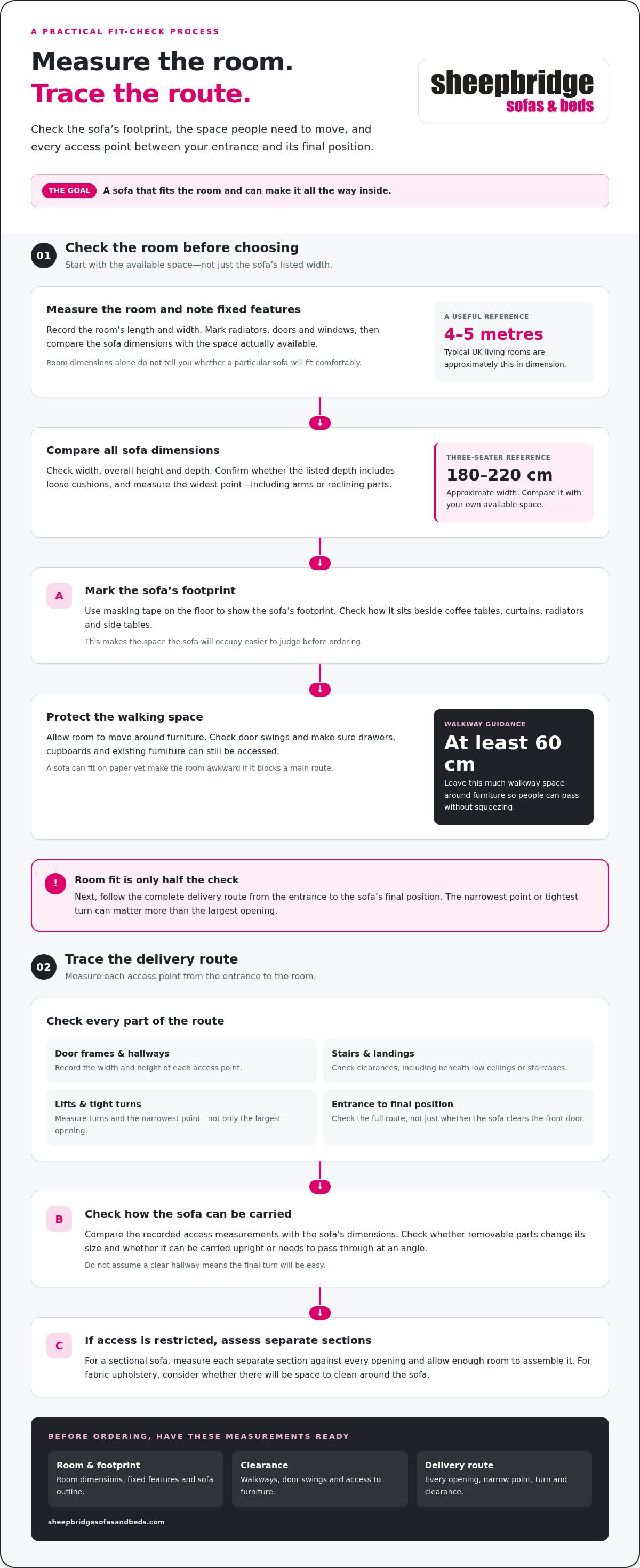
A sofa must fit the room and the route into it. Measure the room’s length and width, then note fixed features such as radiators, doors and windows. Typical UK living rooms are 4-5 metres in dimension, but that alone won’t tell you whether a particular sofa will fit comfortably. A three-seater is approximately 180-220 centimetres wide, so compare its dimensions with your own available space.
Measure more than the sofa’s width. Check its overall height and depth, including whether the listed depth accounts for loose cushions. Record the widest point, including the arms or reclining parts. Then mark the sofa’s footprint on the floor with masking tape. This helps you see how it will fit beside a coffee table, curtains, radiators and side tables.
Allow room to move around it. Leave at least 60 centimetres of walkway space around furniture, so people can pass without squeezing between the sofa and a wall or table. Consider where doors open and whether drawers, cupboards or other existing furniture need clear access. A sofa that fits on paper can still make a room awkward if its footprint blocks a main route.
Next, measure the full delivery route from the entrance to the room. Check door frames, hallways, stairwells, landings, lifts and tight turns. Record the width and height of each access point, then compare them with the sofa’s dimensions. A wide sofa might clear the front door but not turn on a narrow landing. Measure the narrowest point, not just the largest opening.
Use a tape measure and write down each measurement, including clearance beneath low ceilings or staircases. Check whether removable parts affect the dimensions and whether the sofa can be carried upright or must pass through at an angle. These details help you assess whether it can reach the room and be positioned safely. Don’t assume that a clear hallway means the final turn will be easy.
If access is restricted, check whether a sectional sofa’s separate sections can pass through each opening. Measure each section and allow enough room to assemble it. For fabric upholstery, consider whether there will be space to clean around the sofa. Measuring before ordering can help prevent access problems and avoid choosing a piece that overwhelms the room.
2. Checking stock status and delivery expectations
Extra charges can include delivery, assembly and protection treatments, added to the sofa’s purchase price. Ask what the delivery service covers, including whether it brings the sofa into your living room, and compare the full amount before you commit.
Stock status affects timing. A sofa ready for delivery and one made to order may follow different schedules, so establish which applies before planning around its arrival. Some UK sofa delivery offers advertise delivery in 3-10 days, but that window isn’t universal. Treat the date provided for your purchase as essential when organising decorating, flooring work or removal of existing furniture.
Allow some flexibility in your plans. If delivery is delayed, a newly decorated living room may be left without seating, or your existing sofa may be removed too soon. Avoid scheduling other work around an assumed delivery date. Keep the route clear for the confirmed arrival and note any delivery arrangements with your order.
Clarify the delivery service’s scope and cost. Delivery to the door may differ from bringing a sofa inside, and installation may be separate. Check what is included and add any optional extras to your total. Sheepbridge Sofas & Beds provides a two-person delivery service with installation for sofas and beds, and removes packaging. Flat-packed furniture is not assembled. Comparing the full cost helps you see what you’ll pay to get the sofa ready to use.
Returns and warranty coverage also affect the value of a purchase. Read the seller’s returns policy before ordering, including any conditions, deadlines or costs that apply. Check what the warranty covers for the frame and upholstery, and how to report a problem. A good sofa guarantee should run for at least 15 years. Compare the written terms, not just the word “guarantee” in a sales description.
Payment plans can involve extra charges, too. According to the Financial Conduct Authority, rent-to-own customers reported insurance, additional-warranty and installation fees being added to weekly repayments late in the sales process. Review the total payable and each included charge before agreeing to regular payments. A low weekly figure alone won’t show the complete cost.
On delivery day, inspect the sofa promptly. Set aside five minutes to check the upholstery, frame, seams and any included pieces before signing or disposing of packaging. Compare the delivered item with your order, including its fabric and configuration. Photograph visible damage and report it promptly through the seller’s stated process. A short inspection can help you spot an issue while the delivery details are still clear.
3. Balancing purchase price and durability
A lower purchase price can be appealing, but it doesn’t show how well a sofa will handle everyday use. A well-made, properly cared-for sofa typically lasts eight to fifteen years. Budget sofas used daily may last only a few years, while mid-range sofas are estimated to last around 8 to 10 years or more with care. Treat these as guides, then weigh construction, upholstery and your household’s lifestyle.
Look at the frame and support, not just the fabric or cushions. Solid hardwood frames, joined with screws or proper joints, are signs of quality compared with frames held together by staples. Springs, webbing and high-quality fillings also matter because weak structures or poor internal materials can lead to lost comfort over time. Check the frame and seat support when comparing models, and read any warranty terms alongside the construction details.
Upholstery should suit the way you’ll use the sofa. For general everyday use, fabric with a rub count above 20,000 is a solid choice. For daily family use, around 25,000 or more is recommended; a count of 30,000 or more is described as a long-lasting option for a premium sofa. If children or pets share the living room, consider how the surface handles marks and cleaning. A fabric that looks good but is difficult to maintain may add effort over the years.
Leather also needs a closer look. Some sofas described as “100% real leather” combine real leather with bonded or faux leather, which can peel. Read the upholstery description carefully so you understand what covers each part. For fabric, check whether covers are removable and washable, as this can make maintenance easier. For leather, include the recommended care in your ownership plans: conditioning twice per year is advised.
Compare how the sofa feels as well as how it’s built. Sit for several minutes, try different positions, and assess the backrest, seat depth and support. A very firm seat may not suit someone who likes to lie down, while one that’s too soft may not provide enough support. A seat depth of around 55 to 60 centimetres suits people who prefer sitting upright. Test cushions and comfort as a household, not just by appearance.
Finally, compare the sofa’s expected service with how often it will be used. A three-seater in a busy family room faces different demands from seating used occasionally. Choose upholstery and construction for that role, then follow the care guidance: rotating seat cushions weekly can help keep their fill even. This broader comparison helps you judge value beyond the price tag.
4. Budgeting for the sofa and additional charges
Before buying, check how the payment method affects the amount you’ll pay overall. Confirm whether VAT is included in the quoted price, how much deposit is due, what cancellation conditions apply, and whether your chosen payment method adds a fee.
Start with a total budget, not just the sofa’s ticket price. Add the purchase price to delivery, assembly and any protection treatment. Then account for other room needs, such as a suitable side table or replacement cushions. Separating the main seating purchase from supporting furnishings helps show what you can spend without overlooking essentials.
Write down each charge separately. Compare the sofa price with delivery and installation, then add optional extras only if you plan to buy them. This helps reveal when a low headline price doesn’t reflect the full cost. Keep the quote or order summary so you can compare like with like.
Apply the same careful arithmetic to payment plans. Compare the total payable and regular repayments with your household budget, rather than judging affordability by a weekly or monthly figure alone. According to the Financial Conduct Authority, rent-to-own customers reported insurance, additional-warranty and installation fees being added to weekly repayments late in the sales process. Include every listed charge before deciding.
A deposit affects how much you need to pay and when. Read the deposit terms before paying, including when the balance is due and what cancellation conditions apply. Check whether your payment method adds a fee, and record these details alongside the sofa’s quoted price rather than relying on memory after a showroom visit.
Budget for the room as well as the sofa. A new colour or leather finish can change how existing furnishings look, but replacing them immediately may not be necessary. Decide what must change now and what can wait. For an occasional-use room, prioritise what that space needs instead of paying for features your household rarely uses.
Before committing, review the final amount and confirm that it covers the sofa configuration you chose and all applicable delivery charges. Check which services are included, whether installation applies to your purchase, and whether any selected extras are listed. Make sure the deposit and remaining balance are clear. This final review can catch misunderstandings about the total or what the service includes.
To make the budget workable, set aside the amount you can afford regularly and compare it with the full purchase total. A sofa costing £600 can be saved for in six months by putting aside £100 each month. Use that example as a planning method, not a sofa price guide; your own target depends on the sofa and charges you choose.
5. Calculating the full cost of a sofa
Compare the amount you’ll pay to get each sofa home and ready to use, not just its displayed price. Include delivery, assembly and disposal of your existing sofa as separate lines. Disposal isn’t part of the basic purchase calculation unless you add it, so include its charge where applicable. Use the same checklist for every option, whether it’s a compact two-seater or a larger corner sofa.
On the market, sofa prices typically range between £688 and £2,000, with a median of about £1,400. These are market figures, not a quote for a particular sofa. For a fair comparison, note the delivered price alongside seating capacity, upholstery, stock status and delivery expectations. Two sofas with similar prices may differ in what the delivery includes or how soon they can arrive.
Check that the sofa suits your household before comparing totals. Match its seating capacity to the number of people who regularly use the living room, and consider whether the upholstery suits everyday wear. For a corner sofa, check which side the corner sits on and how the layout affects usable seating. Compare the product dimensions with your space and access route, so a lower-priced option doesn’t become an impractical purchase.
To compare prices including delivery, assembly and disposal, add each applicable charge to the sofa’s purchase price, then compare the resulting totals. Keep optional extras separate, and make sure each quote describes the same delivery service and sofa configuration. If one total excludes taking away existing furniture, include that cost before deciding.
Finance needs its own comparison. Look beyond the weekly or monthly repayment and identify the total payable, payment period, deposit, interest and any added fees. The Financial Conduct Authority says rent-to-own customers reported insurance, additional-warranty and installation fees being added to weekly repayments late in the sales process. For buy-now-pay-later plans, read the repayment terms and note any charges triggered by missed or late payments.
Durability helps put the total into perspective. No single example predicts how long every sofa will last: construction, upholstery, care and frequency of use all matter. Compare the frame, fillings and warranty terms alongside the full cost, rather than choosing on appearance alone.
Make a simple comparison table with a row for each sofa and columns for purchase price, delivery, assembly, disposal, finance total, dimensions and stock status. Add the figures before choosing, and mark any optional item clearly. For a suitable layout, explore corner sofa options as part of your comparison.
Sheepbridge Sofas & Beds: Manual Recliner Sofas
Sheepbridge Sofas & Beds offers Manual Recliner Sofas for shoppers comparing comfort, layout and the full cost of a new sofa. If you want reclining seating, compare a manual option with Electric Power Recliner Sofas and consider which suits your household and budget. For a different room layout, Corner Sofas and Fabric Sofa Suites offer further choices.
Use these checks to compare dimensions, delivery arrangements, upholstery and any additional charges before choosing. That makes it easier to focus on the sofa that suits your space and everyday needs, rather than price alone.
Explore the sofa options at sheepbridgesofasandbeds.com or contact Sheepbridge Sofas & Beds to discuss your choice.
Make your next sofa choice with confidence
Start by deciding what matters most in your home: a particular seating arrangement, a reclining position or upholstery suited to your everyday routine. That priority can help narrow your options before appearance alone takes over. It also keeps avoiding hidden costs when buying a sofa focused on the decision that matters: choosing something that fits your space, needs and budget.
Sheepbridge Sofas & Beds offers Manual Recliner Sofas, Corner Sofas and Electric Power Recliner Sofas. Use these categories to consider which type of seating best fits your needs, then apply your checklist as you choose.
There’s no need to rush. A considered decision is easier to feel comfortable with long after the sofa arrives. Contact Sheepbridge Sofas & Beds to take the next step in finding seating that feels right for your home.
Frequently Asked Questions
What Is the Best Way to Budget for a Sofa?
Set a maximum total budget before browsing, then compare the complete amount due rather than the displayed sofa price. Include any delivery, assembly or optional treatment charges, and decide which features matter most for your household. For avoiding hidden costs when buying a sofa, keep a written comparison of each option’s total and payment terms. If paying over time, consider the total payable, not only the instalment amount.
How much does sofa delivery and installation cost in the UK?
There isn’t one standard UK delivery charge: arrangements vary by retailer and service. Check whether the quoted amount covers delivery, installation and packaging removal, or whether these are separate. In Northern Ireland, Sheepbridge Sofas & Beds provides free delivery and installation, with packaging removed after installation. The service is a two-person delivery, helping you compare what’s included in the overall cost.
Do UK sofa retailers charge extra for stairs, difficult access or old sofa removal?
Delivery arrangements depend on your address and access route. Sheepbridge Sofas & Beds delivers to the door and may place items inside if access is clear. If there’s an access issue, you must sign a waiver. The service doesn’t include removing old furniture. If you’re replacing a sofa, plan separately for the existing one and don’t assume the delivery team will take it away.
Are fabric protection plans and extended warranties worth the extra cost?
Protection plans are worth considering only if their cover addresses a risk you’re concerned about and the terms justify the added expense. Compare what the plan covers, which stains or damage it excludes, and how claims work. For an extended warranty, check the covered parts, duration and exclusions, particularly for the frame and upholstery. Also compare the plan with the sofa’s care instructions and any warranty included.
What measurements and access checks help avoid unexpected sofa delivery costs?
Measure the intended space, then check the complete route from your entrance to the room, including doorways, hallways, stairs, landings and tight turns. Compare those measurements with the sofa’s widest point, height and depth. Leave at least 60 centimetres for walkways around furniture. For a reclining sofa, consider its position in the room and whether surrounding furniture could obstruct normal use.