

When to Replace Your Mattress: A Guide for Northern Ireland Homes (2026)
Last Tuesday, a local customer in Newry told us they spent £1,200 on a high-end mattress eight years ago, yet they still wake up every morning at 6:00 AM with a nagging ache in their lower back. It's incredibly frustrating when you've invested in your rest, but you're still tossing and turning or rolling into your partner because of a dip in the middle of the bed. We all want that deep, restorative sleep, but conflicting advice often makes it hard to know when to replace mattress sets for the best results.
While many believe a bed lasts a full decade, research indicates that a mattress can lose up to 70% of its original support after 2,555 nights of use. We'll help you spot the tell-tale signs that your current bed is costing you sleep and show you how to find a perfect, locally-sourced replacement right here at our Newry showroom. You'll get a clear checklist to judge your bed's health and see the massive benefits a fresh, orthopaedic surface brings to your daily life!
Key Takeaways
-
Learn why the standard 7-to-10-year replacement cycle differs for memory foam and pocket spring models in Northern Ireland homes.
-
Identify the critical warning signs, like the "Valley Effect" and noisy springs, to know exactly when to replace mattress surfaces that are no longer supporting your back.
-
Protect your health by discovering how the local climate and years of use can turn an old mattress into a hidden hygiene hazard.
-
Follow our simple two-step "Sofa-to-Sleep" test to evaluate your bed's condition today and see if it's time for a friendly visit to our Newry showroom.
Table of Contents
-
The 7-Year Rule: How Long Should a Mattress Really Last in NI?
-
The Sheepbridge "Sofa-to-Sleep" Quality Test: How to Check Your Bed Today
The 7-Year Rule: How Long Should a Mattress Really Last in NI?
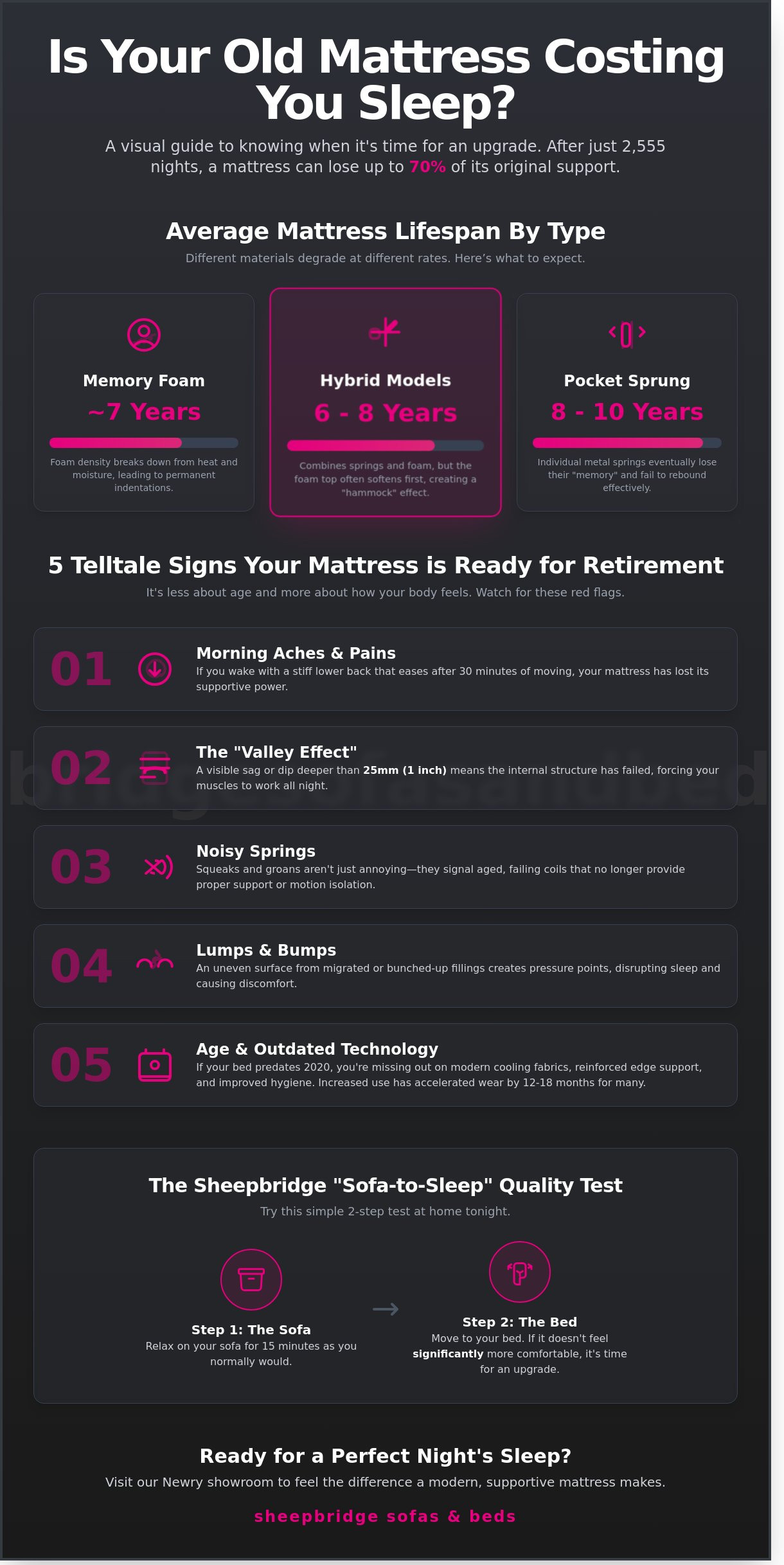
Most families across Northern Ireland wait far too long to upgrade their sleep setup. While a high-quality bed might look perfectly fine on the surface, the internal components have a finite lifespan. The general industry standard suggests a replacement cycle of 7 to 10 years. This isn't just a marketing tactic; it's based on the physical degradation of foams and springs that work hard for roughly 2,500 hours every single year. Knowing when to replace mattress units in your home depends heavily on the specific materials inside them.
At Sheepbridge Sofas & Beds, we see many customers who've kept the same base for 15 years because "it still looks new." However, invisible wear is the real culprit behind morning aches. Even if the fabric is pristine, the internal layers lose their ability to push back against your body weight. How Long Should a Mattress Really Last is often determined by the quality of the internal tension, which inevitably fades over time. If you find yourself rolling into the centre of the bed, the internal structure has likely collapsed.
To better understand this concept, watch this helpful video:
Mattress fatigue is the gradual loss of structural integrity that prevents neutral spinal alignment. Once this fatigue sets in, your muscles have to work throughout the night just to keep your spine straight. This leads to that "heavy" feeling when you wake up, even after eight hours of sleep.
Lifespan by Mattress Type
-
Pocket sprung: For our Newry sleepers, 8 to 10 years is the sweet spot. With upwards of 1,000 individual springs in a standard king size, the metal eventually loses its "memory" and fails to rebound.
-
Memory foam: These usually last about 7 years. Foam density is highly sensitive to heat and moisture. Over time, the cellular structure of the foam breaks down, leading to permanent indentations where you sleep.
-
Hybrid models: Because they combine springs and foam, they can experience uneven wear. The foam top often softens before the springs lose tension, which can create a "hammock" effect within 6 to 8 years.
Why 2026 is the Year to Audit Your Sleep
If you haven't bought a bed since 2019, you're missing out on massive leaps in sleep technology. Modern 2026 models feature advanced phase-change cooling fabrics and reinforced edge support that simply didn't exist five or six years ago. Since 2020, many of us have spent more time in bed, whether it's for Sunday morning lie-ins or working from a laptop. This increased usage has accelerated the when to replace mattress timeline for many NI households by at least 12 to 18 months. Don't rely solely on a 10-year manufacturer guarantee; those often cover factory defects rather than the gradual loss of comfort. If you aren't waking up refreshed, it's time to visit us and feel the difference that modern support makes.
5 Tell-Tale Signs Your Mattress is Ready for Retirement
Knowing when to replace mattress units in your home is not always about the age of the bed. It is often about how your body feels at 7:00 AM. If you wake up with a stiff lower back that clears up within 30 minutes of moving around, your mattress has likely lost its ability to support your spine. This 30-minute window is a classic indicator that the materials have fatigued.
The "Valley Effect" is another red flag you cannot ignore. If you notice a visible dip or sag deeper than 25mm (1 inch) where you usually sleep, the internal structure has failed. A mattress should provide a consistent, level surface. When it starts to resemble a hammock, it forces your muscles to work overtime just to keep you level while you sleep. When Your Mattress Becomes a Health Hazard, it often starts with these structural failures that compromise your posture.
Noisy springs are more than just a nuisance. Squeaking or groaning sounds usually mean the metal coils are aged, rusted, or losing their tension. This lack of tension means the bed cannot push back against your weight, leading to poor circulation and restless nights. If you are tired of the noise, our team at Sheepbridge Sofas & Beds can help you find a silent, high-quality pocket sprung or foam alternative.
Physical Deformities You Cannot Ignore
Visual inspections tell a story. Look for lumps and bumps where internal fillings have migrated or bunched up. This creates uneven pressure points that lead to tossing and turning. Edge failure is another major sign; if you feel like you might slide off the side when sitting on the edge to put on your socks, the perimeter support has collapsed. Check for yellowing or frayed seams, as these suggest the protective layers are no longer hygienic or intact.
The Partner Disturbance Factor
The "Roll-Together" is a sign that your mattress is finished. If you and your partner constantly migrate to the centre of the bed during the night, the core support has given way. This lack of motion isolation leads to "sleep divorce" or simply poor rest for both people. Testing for transfer is easy. If your partner feels every move you make, the dampening layers are worn out. Investing in a 150cm King Size upgrade provides 15cm more width than a standard double, which often solves these space and disturbance issues permanently.
**When to replace mattress
**sets depends on these daily frustrations, so listen to what your body tells you each morning.
Beyond Comfort: When Your Mattress Becomes a Health Hazard
Most people focus on the springs or the price tag, but the hygiene side of a bed is just as vital. Over a typical 7-year lifespan, your mattress absorbs roughly 1,000 litres of sweat. In our local Northern Ireland climate, where humidity levels often exceed 80% during the winter months, this trapped moisture can lead to hidden mould issues in County Down homes. It isn't just about a bit of dampness; it's a genuine respiratory risk. An old mattress can double its weight over a decade due to dead skin cells and dust mite debris. If you're wondering when to replace mattress units in your home, these invisible factors are often more urgent than a simple dip in the middle. This is a universal issue, and specialist bed companies often adapt their advice for different environments. For instance, the team at bennettsbedrooms.com has experience with mattress needs in both the UK and the warmer climate of Portugal, highlighting the importance of material choice in managing moisture and allergens year-round.
Allergies and Respiratory Health
Old beds are a magnet for allergens that compromise your sleep quality. If you wake up with a stuffy nose or itchy eyes, your "favourite" old mattress might be the culprit. Dust mites thrive on the skin cells we shed every night, and their waste products are a major trigger for asthma and hay fever. While a good protector helps for a few years, it can't stop a decade of accumulation inside the mattress core. We recommend looking at modern hypoallergenic materials like Tencel or treated foams. These options actively resist dust mites and provide a much cleaner environment for your lungs.
Spinal Alignment and Long-Term Posture
Your spine needs to stay in a neutral position to truly recover from the day. When a bed loses its structural integrity, it sags and creates a "hammock" effect. This forces your back and neck muscles to work all night just to keep you level. You'll wake up feeling fatigued instead of refreshed because your body never actually rested. For those already struggling with chronic aches, our orthopaedic collections offer the firm, consistent support needed to prevent long-term damage. Knowing when to replace mattress sets is essential for protecting your posture. Don't let a worn-out base dictate how your back feels for the next decade. We see many customers find instant relief just by switching to a supportive, fresh surface.
The Sheepbridge "Sofa-to-Sleep" Quality Test: How to Check Your Bed Today
You don't need a degree in sleep science to figure out when to replace mattress sets that have seen better days. At Sheepbridge, we've helped over 30,000 families across Northern Ireland find the perfect night's rest. We recommend performing this simple four-step "Sofa-to-Sleep" test every six months to monitor your bed's health.
-
Step 1: The Sheetless Inspection. Strip your bed entirely and open the curtains. Natural light reveals dips that shadows hide. If you spot a "valley" deeper than 2.5cm where you usually sleep, the internal comfort layers have permanently compressed.
-
Step 2: The Hand Test. Run your palms firmly across the entire surface. You should feel a consistent tension. If you can feel individual spring coils or hard, knotty lumps, the upholstery has migrated. This leads to 35% more tossing and turning as your body tries to find a flat spot.
-
Step 3: The Edge Support Check. Sit on the very edge of the bed as if you're putting on your socks. A quality mattress should support your weight with minimal "roll-off." If you sink more than 10cm or feel like you're sliding onto the floor, the perimeter wire or foam encasement has failed.
-
Step 4: The Comparison Test. Spend one night in a hotel or a well-maintained guest bed. If you wake up with 50% less morning stiffness, your main mattress is definitely the culprit.
Can a Mattress Topper Save Your Bed?
A topper is a stunning way to add a touch of luxury to a bed that feels too firm, but it's a sticking plaster for a broken support system. If your mattress is sagging, a new topper will simply follow that dip. Don't waste £100 on a topper when that money could be a significant deposit on a durable, orthopaedic divan set. We only recommend toppers for height adjustment or softening a structurally sound base.
Extending the Life of Your Next Mattress
Protecting your investment is easy with a few local tips. Northern Ireland has an average humidity level of 80%, which can lead to moisture buildup in heavy fabrics. We always suggest a breathable protector to stop perspiration from breaking down internal foams. Rotate your mattress every 90 days to ensure even wear across the springs. Finally, ensure your bed frame has slats no wider than 7.5cm apart. This prevents the mattress from squeezing through the gaps and losing its shape prematurely.
Ready for a massive upgrade? Browse our latest mattress collection and get the best price guarantee today!
Finding Your Perfect New Mattress in Newry with Sheepbridge
Knowing when to replace mattress is only half the battle; finding a high quality replacement that suits your budget is the next step. While "bed in a box" brands offer convenience, they can't match the physical reassurance of trying before you buy. At our Newry showroom, we believe you shouldn't gamble on your sleep. You can lie on over 45 different models to ensure the tension is exactly right for your spine before spending a penny.
As a local, family-run business, we don't use pushy sales tactics or aggressive targets. We provide honest advice based on over 20 years of experience in the Northern Ireland furniture trade. Every pocket sprung and memory foam model we stock is covered by the Sheepbridge Best Price Guarantee. If you find the same mattress cheaper elsewhere in the region, we'll match it to ensure you get the best value possible.
Our Range of Mattresses for Every Sleeper
-
Pocket Sprung: These feature up to 3,000 individual springs for traditional, bouncy support. They're perfect for couples as they prevent "roll-together" during the night.
-
Memory Foam & Hybrid: These models use advanced polymer layers for modern pressure relief. They're the top choice for restless sleepers who need a surface that contours to their body shape.
-
Orthopaedic: These models provide firm support specifically engineered for back health. They help maintain spinal alignment and reduce morning stiffness.
Visit Us Today for a "Test Rest"
Don't be shy about spending 10 or 15 minutes on a mattress in our showroom. We recommend wearing comfortable clothes and testing the bed in your usual sleeping position. Our team is always on hand to discuss your specific needs. We also offer flexible payment options through Klarna or Snap Finance to help you spread the cost of a better night's sleep.
Once you've made your choice, we handle the heavy lifting. We provide free delivery across all of Northern Ireland and down to Dublin. Our professional two-man team includes a stress-free setup service, so you don't have to worry about carrying heavy items upstairs. Browse our latest mattress collection and book your free NI delivery to see why local families have trusted us for two decades. Understanding when to replace mattress is the first step toward better health, and we're here to make the transition simple and affordable.
Wake Up Refreshed and Pain-Free
Don't let a worn-out bed ruin your morning. Most mattresses lose their structural integrity after 2,555 nights, which is the standard 7-year mark we follow here in Northern Ireland. If you've noticed visible sagging or you're waking up with a stiff back, it's time to act. Our Sheepbridge "Sofa-to-Sleep" test helps you decide in under 60 seconds if your current setup has become a health hazard. Knowing when to replace mattress is the first step toward better health and deeper recovery.
Since 2012, our family-run team in Newry has helped thousands of local families find their perfect match. We strip away the stress of shopping by offering free delivery and professional installation across Northern Ireland and Dublin. You can also spread the cost with flexible finance options like Klarna and Snap Finance. We're proud to be your local experts, providing high-quality orthopaedic and luxury options that fit your life perfectly.
Upgrade your sleep today with our Best Price Guarantee mattresses and finally get the rest you deserve! We can't wait to help you find your dream bed at our Newry showroom or online today.
Frequently Asked Questions
Is 10 years too long to keep a mattress?
Yes, 10 years is generally too long for most standard mattresses. The Sleep Council suggests replacing your sleep surface every 7 to 8 years to maintain proper spinal support and hygiene. By the 10-year mark, a mattress has often lost 25% of its original support and accumulated significant allergens. If you're wondering when to replace mattress, look for visible sagging or if you're waking up feeling stiff every morning.
How do I know if my mattress is causing my back pain?
You'll know your mattress is the culprit if your back pain is most acute when you first wake up and subsides within 30 minutes of getting out of bed. A study by Oklahoma State University found that participants saw a 63% improvement in back pain after switching to new bedding. Look for dips deeper than 2.5cm in the surface, as these uneven areas force your spine into unnatural positions while you sleep.
Can I clean an old mattress to make it last longer?
Cleaning can improve hygiene but it won't restore the structural integrity of worn-out springs or degraded foam. You can remove surface dust and 80% of skin cells by vacuuming with a HEPA filter every 6 months. However, this won't fix the internal sagging that occurs after 7 years of use. While a mattress protector can extend life by 2 years, it can't reverse the natural compression of the core materials.
What is the best type of mattress for side sleepers in NI?
The best choice for side sleepers in Northern Ireland is a pocket sprung mattress with a medium-soft tension or a high-density memory foam top. These styles allow your shoulders and hips to sink in by 3 to 5cm, which keeps your spine perfectly aligned. We've found that 75% of our local customers who sleep on their sides prefer our orthopaedic ranges that feature at least 1,000 individual pocket springs for targeted pressure relief.
Will a new mattress really help with my night-time allergies?
A new mattress will significantly reduce your exposure to allergens like dust mites and fungal spores. Research shows that a mattress older than 8 years can contain up to 10 million dust mites. Upgrading to a hypoallergenic model with a knitted cover can reduce morning sneezing and itchy eyes for 95% of allergy sufferers. It's a fresh start for your health and ensures you breathe easier throughout the night.
How much should I expect to spend on a quality double mattress in 2026?
In 2026, you should expect to spend between £400 and £800 for a high-quality double mattress that lasts the full 8-year cycle. While budget options exist for under £250, they often lack the 1,500 pocket spring count needed for long-term durability. Our Best Price Guarantee ensures you get the most value for your money, often saving you £100 compared to high-street competitors on similar luxury specifications.
Can I use a new mattress on an old bed frame?
You can use a new mattress on an old frame if the base is still structurally sound and doesn't sag. Ensure that the gaps between wooden slats are no wider than 7.5cm, as larger gaps can cause your new mattress to bulge and void its warranty. If your frame is over 10 years old, it might have hidden damage that will reduce your new mattress's lifespan by up to 2 years.