

What to Look for When Buying a Sofa: A Practical Guide
A sofa is a fit decision before it’s a style decision. If you’re wondering what to look for when buying a sofa, start with more than colour and shape: a favourite design won’t feel like the right choice if it won’t fit your room, pass through the doorway or suit the way your household relaxes.
Appearance matters, but so do comfort, upholstery, construction and useful features. This guide gives you a practical checklist for measuring your space and access route, comparing sofa styles and materials, and thinking through how the sofa will be used each day.
You’ll also find pointers for assessing comfort at our Newry showroom and planning delivery across the island of Ireland. Delivery includes two-person White Glove service, installation and packaging removal. Delivery is free in Northern Ireland and in the Republic of Ireland as far as Drogheda, Ardee and Monaghan. A quote is required beyond those towns. By the end, you’ll have a clearer way to compare options and choose with confidence.
Key Takeaways
- Start with who’ll use the sofa and how, so everyday comfort and function guide your choice alongside appearance.
- When considering what to look for when buying a sofa, compare how it feels in person with the product details for the exact model.
- Measure the sofa’s intended spot, circulation space and access route, then compare every measurement with the product dimensions.
- Use your household routine to weigh upholstery care, colour and useful features before settling on a style.
- Plan delivery as part of your decision: Sheepbridge delivers across the island of Ireland, with two-person installation and packaging removal.
What to look for when buying a sofa: start with how you live
A sofa can bring a room together, but its appearance is only part of the decision. Think about daily comfort and fit just as carefully. A stylish sofa may not suit your household if there aren’t enough seats, it doesn’t support the way you like to relax, or its function doesn’t match your routine. Picture an ordinary day in the room, not just how the sofa will look when nobody’s sitting on it.
Start with the people who’ll use it. Is it the main family seat, a quieter spot for reading, or somewhere guests gather? Consider how often it’ll be used, whether children or pets share the space, and whether the room also needs to work for watching television, conversation or stretching out. Sofa designs and materials vary widely, as the Couch Wikipedia article illustrates, but your household’s routine is the most practical place to begin.
Match the sofa to your household routine
Be specific about how you sit. Do you prefer an upright position, put your feet up, or stretch out across a seat? Do several people settle down together most evenings? These habits can help you decide whether to compare a standard sofa, a corner sofa, or a manual or electric power recliner. If the sofa gets frequent use, consider comfort and upholstery care early, especially in a busy home with pets or children.
Choose for the routines your household repeats, and the sofa is more likely to work for real life as well as the room.
Set priorities before browsing sofa styles
Before looking through colours and shapes, write down what the sofa needs to do. Separate non-negotiables from preferences, so an attractive finish doesn’t distract from an essential requirement. For broader local shopping context, the Newry sofa buying guide offers another perspective on choosing a sofa in the area.
- Dimensions: Note the maximum space available, then compare it with the product dimensions.
- Seating capacity: Decide how many people should be able to sit comfortably during everyday use.
- Preferred function: Consider whether a fixed seat or reclining function better suits how you relax.
- Finish: Treat colour and decorative details as preferences unless they solve a practical need in the room.
Some priorities depend on one another. A larger household might need more seats, but limited floor space could make the sofa’s footprint a firm limit. If reclining is important, make it a requirement rather than assuming it can be added later. Keep your list handy while browsing. It gives you a consistent way to compare options and helps you move from “I like the look” to “this suits our home.”
Once you know who’ll use the sofa and what matters most, you’ll have a clearer starting point for comparing comfort and construction, then checking the room and access route.
Compare sofa comfort and construction beyond first impressions
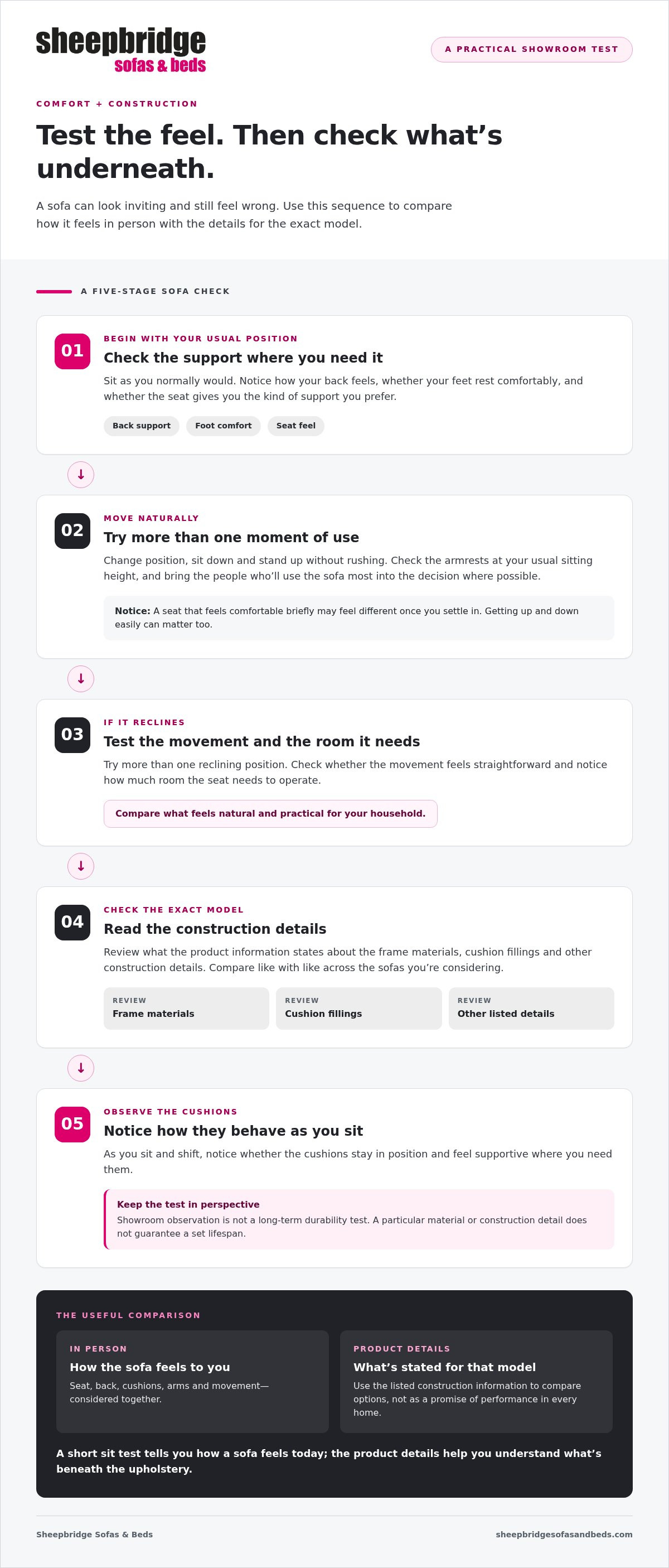
A sofa can look inviting and still feel wrong once you sit down. Comfort is personal, so use your own body and usual sitting position to judge support rather than relying on appearance or a short product description. If you’re working out what to look for when buying a sofa, treat a showroom visit as a practical test. Notice how the seat, back and arms feel, and whether you can move comfortably.
Try the sofa as you’d use it at home. Sit back, change position and stand up again. A seat that feels comfortable for a brief moment may feel different when you settle in, while getting up and down easily can matter just as much as cushioning. Bring the people who’ll use it most into the decision where possible.
Test sitting comfort in a useful way
Start with the position you use most. Check that your back feels supported, your feet rest comfortably and the seat gives you the kind of support you prefer. Notice whether the armrests feel comfortable at your usual sitting height. Then stand up and sit down without rushing. This helps you judge whether the sofa suits its intended users, not just the person who happened to test it first.
If the sofa has reclining seats, try more than one position and check that the movement feels straightforward. Notice how much room the reclining seat needs to operate. You don’t need to make a technical assessment; simply compare what feels natural and practical for your household. For a closer look at comfort in person, you can try sofa comfort at the Newry showroom.
A short sit test tells you how a sofa feels today; the product details help you understand what’s beneath the upholstery.
Look beyond the upholstery to the sofa structure
After trying the sofa, review the information for that specific model. Product descriptions may list frame materials, cushion fillings or other construction details. Read what’s stated and compare like with like across the sofas you’re considering. Don’t assume that a particular material or construction detail guarantees a set lifespan; the specification describes the sofa, not how it will perform in every home.
Observe the cushions during ordinary showroom use. Do they stay in position as you sit and shift? Do they feel supportive in the places you need? This isn’t a long-term durability test, but it can help you notice how the sofa feels and whether it suits you. Avoid judging by a single feature alone: comfort depends on how the seat, back, cushions and frame work together for your preferences.
- Support: Notice how the seat and back feel in your usual position.
- Movement: Check sitting down, standing up and changing position.
- Details: Compare the listed frame and cushion information for each model.
- Reclining: Try the operation and consider the space needed around the seat.
Use both sources of evidence: your own comfort test and the written product details. Neither replaces the other, and together they give you a clearer basis for comparing sofas than appearance alone.
Measure the room and access route before choosing a sofa
Measurements help you check two separate things: whether the sofa will work in the room and whether it can reach its intended position. Both matter. A sofa may suit the available floor space but still be difficult to manoeuvre through a narrow hallway or around a stair turn. When deciding what to look for when buying a sofa, measure before ordering and keep the figures together so you can compare them with the exact model you’re considering.
Measure the space where the sofa will sit
Start at the planned position and measure the available width, depth and height. Include the space needed to walk past, open doors and use nearby furniture. Mark the sofa’s footprint on the floor with masking tape or another removable marker. This makes its scale easier to picture and helps reveal whether it could obstruct a route or crowd the room.
Follow this sequence and record each measurement:
- Placement: Measure the maximum width, depth and height available where the sofa will sit. Note features such as radiators or low windows that may affect placement.
- Circulation: Check the walking routes around the planned footprint, along with doors and nearby furniture that need room to open or move.
- Doorways: Measure the clear opening, not just the width of the door itself.
- Hallways and turns: Record the narrowest points and the space available to turn between the entrance and the room.
- Stairs and other access points: Measure the route, including landings and any tight corners the sofa must pass.
Check the full route from the entrance to the room
Take measurements in order, from the entrance to the final position. For each doorway, hall, turn or stair section, note the narrowest usable space. Then compare your notes with the product dimensions, not with a similar-looking sofa. The Estelle Grey Fabric Recliner Sofas three-seater, for example, is listed as 217 cm long, 78 cm deep and 103 cm high. Those dimensions apply to that model and size, not to other sofas.
A simple comparison is a useful first check, but it can’t guarantee that a sofa will pass through every access point. How a sofa can be angled or manoeuvred depends on the route and the particular model, so don’t assume that matching one measurement settles the question. Recliner designs also need usable space for the seat to operate, so consider the area around the planned position as well as the sofa’s stated dimensions.
Keep a written record of the room, route and chosen product measurements. Check each figure against the exact sofa details before ordering, and treat the route as part of the decision, not an afterthought. Careful checks can help you spot a mismatch before delivery day.
Use a practical checklist to compare upholstery and useful features
Once you’ve narrowed down the size and style, compare the details that affect everyday use. A checklist makes it easier to judge each sofa against the same household needs, rather than choosing on colour alone. When deciding what to look for when buying a sofa, focus on how you’ll care for it, which functions you’ll use and which features are listed for that model.
Choose upholstery for the way your home is used
Think about who shares the sofa, how busy the room is, how much daylight it gets and how much time you want to spend on upkeep. Check the care guidance for the exact upholstery before deciding. Fabrics on listed sofas are described as tough wearing, pet friendly and easy wiped. These descriptions don’t apply to every fabric sofa. Fabric and leather each have different considerations; the fabric versus leather sofa guide explores the comparison in more detail.
| What to compare | Questions to ask yourself | What to check |
|---|---|---|
| Household routine | Is this a busy everyday seat, or used occasionally? | Choose a finish and features that suit the way the room is used. |
| Upholstery care | How much upkeep feels manageable? | Read the care guidance for the exact material and model. |
| Colour and daylight | Will the colour work with the room’s light and furnishings? | Consider how the finish looks in the room, not only on a screen. |
| Function | Would fixed seating or a reclining function be more useful? | Check the listed seat configuration and how any recliner operates. |
| Listed features | Which details will you genuinely use? | Look for features such as armrests, headrests or a console in the model description. |
Check functions and details on the exact model
Features can vary between sofas, so read the description for the precise model you’re considering. Check the number and arrangement of seats, whether reclining is manual or electric, and which armrest or headrest details are included. The listed recliner sofas have fully reclining seats. Three-seater models have two reclining positions, while two-seater and armchair models are fully reclining. Don’t assume a feature shown on one sofa comes as standard across the range.
For example, Platina recliner sofas have extra padded armrests and headrests. The three-seater has a dropdown centre console with a charging port. These are features of the Platina models, not standard details on every sofa. A useful final check is to match each listed feature against your checklist. If it won’t help in your home, it doesn’t need to drive your decision.
For example, Estelle fabric recliner sofas are listed at £399, while Platina fabric recliner sofas are listed at £499. Compare the exact model’s upholstery, dimensions and features alongside the price, rather than assuming a higher price means a better fit. Use the table to compare your shortlist, then browse sofa options and compare listed features against the needs you’ve identified.
Plan your sofa purchase and delivery with Sheepbridge
Once you’ve compared sofa details and checked the space at home, include delivery in your decision. You can browse sofas online or visit the Newry showroom to experience furniture in person. That gives you two practical ways to weigh up your options: review model details at your own pace, or try the comfort and finish for yourself.
Delivery is available only to the island of Ireland, covering Northern Ireland and the Republic of Ireland. Delivery is not available to mainland UK. Delivery is free in Northern Ireland and in the Republic of Ireland as far as Drogheda, Ardee and Monaghan. A quote is required for locations beyond those towns.
Know what to expect from delivery day
Sofa delivery includes a two-person White Glove service, with installation and removal of the packaging. The team doesn’t remove old furniture, so make a separate plan for your existing sofa before delivery day. Clear access from the entrance to the sofa’s intended position helps the delivery team bring it into the room and install it. If there’s an access issue, you’ll need to sign a waiver, and the company isn’t liable for damage to the premises or possessions.
Standard delivery takes approximately 10 to 14 days from order confirmation. If an item is out of stock, the timeframe is approximately 10 to 14 days from when it arrives at the warehouse. Your delivery date is confirmed after final payment or confirmed cash-on-delivery. An adult over 18 must sign for the goods. The delivery team will attempt to contact you within two hours of the expected delivery time on the scheduled day. If they can’t reach you, delivery is rescheduled and a £50 redelivery charge applies, payable before the new delivery.
Plan around the confirmed date and leave the route clear. Cancellations must be made at least two working days before the scheduled delivery; delivery can’t be cancelled on the day. Late cancellations incur a redelivery charge. With the delivery details in mind, browse sofas on the Sheepbridge website and compare the options that suit your room and routine.
Choose your next step with confidence
Use the same priorities you’ve applied throughout your search: a sofa should fit its intended space and access route, feel comfortable for the people using it, and have features that make sense for your household. Then consider the delivery area, timing and service so you know what to expect after ordering. A good choice brings those practical details together with the look you want.
If you’d like to assess comfort and finish in person, visit the Newry showroom. If you’re comparing from home, use the online sofa descriptions to review each model’s details. For further Newry-specific advice, the local sofa and delivery guide adds helpful context for shopping in the area.
Taking time to match your shortlist to your measurements, comfort preferences and delivery arrangements makes the final decision clearer. You’ll know why the sofa suits your home, not just why it caught your eye.
Make your shortlist your next step
The best choice isn’t necessarily the sofa with the most features. It’s the one that makes sense for the way you live and feels right in your home. Before deciding, look over your shortlist and ask: would I still choose this sofa if I focused on how it’ll be used every day? That question can bring your priorities back into focus.
Knowing what to look for when buying a sofa gives you a practical basis for choosing, but seeing options in person can help you picture the final decision more clearly. Sheepbridge Sofas & Beds is an independent, family-run retailer based in Newry, serving homes across the island of Ireland.
Take the next step at your own pace. Browse sofas or plan a visit to our Newry showroom and find an option that feels like a natural fit for your home.
Frequently Asked Questions
How do I know if a sofa will fit through my front door?
Measure the narrowest clear opening, including the usable space with the door open, then compare it with the exact sofa dimensions. Also check the hallway, corners and any steps between the entrance and its final position. A doorway’s width alone won’t tell you whether the sofa can be angled through. When deciding what to look for when buying a sofa, measure the whole delivery route, not just the living room.
Is it better to buy a sofa online or in a showroom?
Both can help, depending on what you need to decide. Online product descriptions make it easier to compare listed dimensions, upholstery and features at your own pace. A showroom visit lets you sit on the sofa and see its finish in person. At the Newry showroom, you can experience furniture before choosing. You might compare online first, then visit to assess the feel of the models on your shortlist.
Can sofa upholstery be cleaned with ordinary household products?
Don’t assume ordinary household cleaners are suitable for sofa upholstery. The wrong product or method could affect the material or its finish. Start with the care guidance for the exact sofa, and follow any cleaning instructions provided. Avoid applying a product to a visible area without first checking the care guidance, especially if the upholstery is fabric or leather. If you’re unsure what an instruction means, don’t experiment on the sofa.
How long should I expect a sofa to last?
There isn’t one reliable lifespan for every sofa. Estimates commonly put sofa life at around 7 to 15 years, but that range isn’t a promise for a particular model. How often it’s used, the household routine and how it’s cared for can all affect its condition over time. Rather than relying on an age estimate alone, consider the specific construction details and whether the sofa suits the demands of your home.
What should I check in a sofa’s product description before ordering?
Check that the description matches the exact model and seating size you want. Look for overall dimensions, upholstery details, cushion and frame information, and any listed functions or included features. For a recliner, check which seats recline and whether the operation is manual or electric. Compare the product details with your room measurements and the way you plan to use the sofa, rather than relying on photographs alone.
Does sofa delivery include installation and removal of old furniture?
Sofa delivery includes installation and removal of the packaging, but not removal of your old furniture. Plan separately for the existing sofa before the new one arrives, so it won’t block the route or the space needed for installation. The two-person White Glove service is for the new sofa. If you’re replacing a sofa, make sure there’s clear access from the entrance to its intended position.
Can Sheepbridge deliver a sofa to mainland UK?
No. Sofa delivery is only available on the island of Ireland, so Sheepbridge doesn’t deliver to mainland UK. Delivery is available in Northern Ireland and the Republic of Ireland. Delivery is free in Northern Ireland and as far as Drogheda, Ardee and Monaghan in the Republic of Ireland. Beyond those towns, a quote is required. If you’re in Newry or elsewhere in Northern Ireland, you’re within the stated delivery area.